


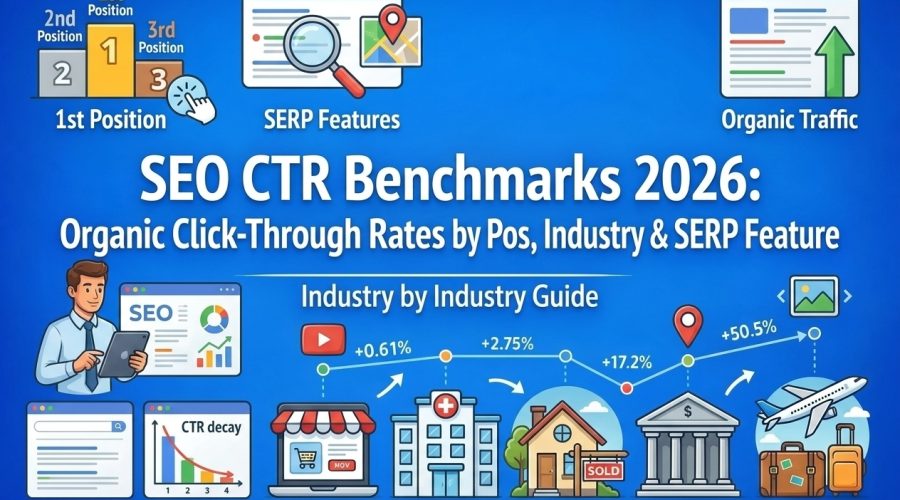
The average organic click-through rate for position 1 in Google Search is 39.8% on clean SERPs in 2026, falling to 19% when an AI Overview is present on the same page. Position 2 averages 18.7% CTR and position 3 averages 10.2%, with CTR dropping below 2% from position 6 onwards. On mobile, position 1 CTR averages 25–27% — roughly 10 percentage points lower than desktop — due to screen space being dominated by ads and AI features.
Source: DollarPocket.com analysis of Semrush, Ahrefs, GrowthSRC and First Page Sage data (2026). Full position-by-position breakdown below.
Sources: First Page Sage 2026; GrowthSRC (200,000+ keywords); Ahrefs Feb 2026; Incremys 2026.
The 2026 CTR Landscape: What Changed and Why Organic click-through rate benchmarks were relatively stable from 2015 to 2022. The top position consistently attracted 25–40% of clicks depending on the study methodology. Positions 2 and 3 each captured meaningful shares. The curve was steep but predictable, and SEOs could reliably forecast traffic from rank improvements. Three structural changes have broken that predictability in 2026, and each one compounds the others. The first is AI Overviews. Google's AI-generated answer panels now appear on approximately 31% of all search result pages according to GrowthSRC's analysis of over 200,000 keywords — up from fewer than 10,000 keywords in August 2024. When an AI Overview appears, the first organic result is pushed below the fold. According to Seer Interactive's November 2025 analysis, overall organic CTR drops from 1.76% to 0.61% — a 65% decline — on queries where AI Overviews appear. Position 1 specifically loses 54.9% of its expected clicks according to Semrush's study of 17.8 billion search queries. The second is zero-click search growth. Approximately 60% of all Google searches in 2026 end without a click to any external website, according to data compiled by Incremys citing multiple 2025–2026 studies. Users get their answers directly from featured snippets, knowledge panels, AI Overviews, and local packs — and never visit a website at all. The third is SERP feature proliferation. In 2026, a typical Google search results page may simultaneously show paid ads, an AI Overview, a featured snippet, a local pack, image results, video results, and a People Also Ask box — all before the first traditional organic result. Each element competes for the user's attention and click.| Position | CTR — Clean SERP | CTR — With AI Overview | CTR — With Featured Snippet | YoY Change (Position CTR) |
|---|---|---|---|---|
| Position 1 | 39.8% – 41.3% | ~5% – 19% MailOnline desktop: <5% / GrowthSRC broad avg: 19% | 38.9% – 42.9% | –32% (AI Overview SERPs) |
| Position 2 | 18.7% | 7% – 12% | 27.4% – 29.5% | –39% (AI Overview SERPs) |
| Position 3 | 10.2% | 8% – 10% | 10.2% | –23% |
| Position 4 | 7.2% | 6% – 7% | 7.2% | –12% |
| Position 5 | 5.1% | 4% – 5% | 5.1% | –17% |
| Position 6 | 4.4% | 4% – 5% | 4.4% | +30% avg (pos 6–10) |
| Position 7 | 3.0% | 3% – 4% | 3.0% | +30% avg (pos 6–10) |
| Position 8 | 2.1% | 2% – 3% | 2.1% | +30% avg (pos 6–10) |
| Position 9 | 1.9% | 2% – 3% | 1.9% | +30% avg (pos 6–10) |
| Position 10 | 1.6% | 2% – 3% | 1.6% | +30% avg (pos 6–10) |
| Top 3 combined | 68.7% of all clicks | ~35% of all clicks | — | Significant decline |
Sources: First Page Sage 2026 (clean SERP data, meta-analysis); GrowthSRC CTR Study (200,000+ keywords, 2025–2026); Semrush Organic Search CTR Study (17.8 billion queries, 4.2 million search terms, 28 countries). YoY change for AI Overview SERPs: GrowthSRC position 1 dropped from 28% to 19% (–32%); position 2 from 20.83% to 12.60% (–39%). Positions 6–10 increased +30% avg on AI Overview SERPs as users scroll deeper.
| SERP Feature | CTR | Notes |
|---|---|---|
| Featured Snippet (Position 1) | 42.9% | Highest CTR of any SERP element. Outperforms standard position 1 by ~3 pp |
| Featured Snippet (Position 2) | 27.4% | Significantly outperforms standard position 2 (18.7%) |
| AI Overview (Position 1 below it) | ~5% – 19% | GrowthSRC broad average: 19% (–32% vs clean SERP). MailOnline real-world desktop data: under 5% (Press Gazette, Nov 2025). Range reflects different site sizes and query types — both are correct for their populations. Largest CTR suppressor in 2026 |
| Cited within AI Overview | +35% vs not cited | Pages cited as AI Overview sources see CTR increases of up to 35% (Seer Interactive, Nov 2025) |
| Standard Organic Position 1 | 39.8% | Clean SERP — no AI Overview, no local pack, no featured snippet |
| Local Pack Position 1 | 17.6% | Google Business Profile / Maps result |
| Local Pack Position 2 | 15.4% | Small drop from position 1 — local pack CTR is tightly clustered |
| Local Pack Position 3 | 15.1% | Nearly identical to position 2 — local pack positions are close in value |
| Organic with local pack present | 23.7% (pos 1) / 15.1% (pos 2) | Local pack reduces organic position 1 CTR from 39.8% to 23.7% |
| Paid Ad Position 1 | 2.1% | Top paid position. Organic position 1 receives 19× more clicks than top paid result |
| Paid Ad Position 2 | 1.4% | 40% lower CTR than position 1 paid |
| Paid Ad Position 3 | 1.3% | — |
| Video Result | 2.3% – 6.4% | Wide range depending on query intent and video thumbnail quality |
| Image Result | 1.4% – 4.9% | — |
| People Also Ask box | 3.0% | Expanding PAA answers reduces clicks to organic results below |
| Knowledge Panel | 1.4% | Entity-based result. Low CTR but high brand awareness signal |
| Local Service Ad (left) | 3.1% | Home services and professional services verticals only |
Source: First Page Sage 2026 CTR Meta-Analysis (updated May 2025); Seer Interactive (Nov 2025) for AI Overview citation CTR uplift. All figures represent Google Search "All" tab only — not Maps, Images, News, or Videos tabs.
Organic CTR by Query Type: Branded, Non-Branded, Long-Tail, Informational Query type is the most underreported variable in CTR benchmarks. Position 1 for a branded query and position 1 for a generic head term operate in completely different CTR environments. Understanding these differences is essential for accurate traffic forecasting.| Query Type | Avg CTR (Position 1) | Key Characteristic | Source |
|---|---|---|---|
| Branded queries | 38.6% | Up from 34% in 2025. Users typing your brand name are pre-committed to your site | SparkToro / Moz (4.2M queries, 2026) |
| Non-branded queries | 5% – 10% | Broad informational and commercial queries. CTR varies heavily by SERP features present | Semrush / esignwebservices 2026 |
| Long-tail (4+ words) | 19.7% avg across positions | Higher CTR due to specific intent. Fewer AI Overviews on long-tail queries = less CTR suppression | Semrush State of Search (112M keywords) |
| Single-word head terms | 9.4% avg across positions | Generic, high-competition terms. More SERP features present = lower CTR | Semrush State of Search (112M keywords) |
| Two-word phrases | 13.1% avg across positions | Moderate intent. Mid-level CTR between head terms and long-tail | Semrush State of Search (112M keywords) |
| Informational queries (with AI Overview) | 0.61% overall avg | AI Overviews appear in 99.9% of informational keywords (Ahrefs, Nov 2025). Most traffic loss concentrated here | Seer Interactive / Ahrefs Nov 2025 |
| High-intent service queries (legal, healthcare, finance) | 8% – 15% | Users want trustworthy, specific answers. Higher urgency = higher CTR even at lower positions | esignwebservices / WebFX 2026 |
Sources: SparkToro / Moz (4.2 million branded and non-branded queries, 2026); Semrush State of Search (112 million keywords); Seer Interactive (November 2025); Ahrefs (November 2025); esignwebservices.com 2026 SEO Benchmarks; WebFX 2026 SEO Benchmarks.
| Industry | Avg CTR — Position 1 | Avg CTR — Positions 2–5 | Key Driver |
|---|---|---|---|
| Education | 45.02% (desktop) | 12% – 22% | High trust — users rely on first authoritative source |
| Legal Services | 15% – 28% | 8% – 15% | High urgency — users need answers fast and trust top results |
| Healthcare / Medical | 14% – 26% | 7% – 14% | YMYL — Google prioritises authority sources, users follow |
| Finance & Insurance | 12% – 22% | 6% – 12% | High-intent decisions — users click trusted institutional sources |
| Home Services (HVAC, Plumbing, Roofing) | 18% – 30% | 9% – 16% | Emergency intent — users click first available solution |
| Travel & Hospitality | 10% – 18% | 5% – 10% | Competitive SERP — OTAs dominate, users compare multiple results |
| Retail / eCommerce | 7% – 15% | 3% – 8% | Shopping tabs and Google Shopping reduce organic CTR |
| Technology / SaaS | 6% – 12% | 3% – 7% | Research-heavy audience compares multiple sources before clicking |
| Real Estate | 8% – 16% | 4% – 9% | Local pack and Zillow/Realtor.com dominate many SERPs |
| Food & Recipes | 4% – 9% | 2% – 5% | One of the hardest-hit industries — AI Overviews show full recipes, reducing clicks by 50–70% |
| Cross-industry average (position 1) | ~27.6% – 39.8% | 5% – 18.7% | Depends on SERP context |
Sources: Amra & Elma CTR Statistics 2026; esignwebservices.com 2026 SEO Benchmarks; WebFX 2026 SEO Benchmarks; Ahrefs AI Overview industry data (November 2025). Education desktop CTR: Amra & Elma / Advanced Web Ranking. Food & Recipe traffic loss: Semrush AI Overviews study and individual publisher reports 2025–2026.
Mobile vs Desktop CTR Benchmarks 2026 Mobile accounts for approximately 58–60% of Google searches in 2026 but delivers lower CTRs than desktop across almost every position. The gap exists because mobile SERPs show fewer organic results above the fold, more ad placements, and larger AI Overview panels that push organic results further down. Understanding the device split is essential for accurate traffic modelling.| Position | Desktop CTR | Mobile CTR | Mobile Gap |
|---|---|---|---|
| Position 1 | ~43% (education: 45.02%) | ~26% – 32% | Mobile ~25–35% lower |
| Position 2 | ~22% | ~14% – 17% | Steeper mobile drop between pos 1 and 2 |
| Position 3 | ~12% | ~8% – 10% | Gap narrows below position 3 |
| Positions 4–5 | ~7% – 10% | ~5% – 7% | — |
| Positions 6–10 | ~2% – 5% | ~2% – 4% | Gap minimal at lower positions |
| Share of Google searches | ~40% – 42% | ~58% – 60% | Mobile dominant by volume |
Sources: Advanced Web Ranking CTR Study 2026 (device-segmented data); Amra & Elma CTR Statistics 2026 (education industry desktop CTR); Incremys 2026 (mobile search share). Mobile vs desktop CTR gaps represent general directional benchmarks — actual figures vary by industry and SERP composition.
The AI Overview Effect: What the Data Shows for SEO in 2026 AI Overviews are the single most consequential change to organic CTR in the history of modern SEO. Understanding which industries and query types are most affected — and what to do about it — is now a core requirement for any SEO strategy.| Metric | Data Point | Source |
|---|---|---|
| % of SERPs showing AI Overviews | ~31% | GrowthSRC / First Page Sage 2026 |
| AI Overviews appearing on informational keywords | 99.9% | Ahrefs (November 2025) |
| AI Overviews on Shopping queries | 3.2% | Ahrefs (November 2025) |
| AI Overviews on Real Estate queries | 5.8% | Ahrefs (November 2025) |
| AI Overviews on Science queries | 43.6% | Ahrefs (November 2025) |
| AI Overviews on Health queries | 43.0% | Ahrefs (November 2025) |
| AI Overviews on local searches | 7.9% | Ahrefs (November 2025) |
| Organic CTR decline on AI Overview queries | –54.9% to –65% | Semrush (17.8B queries) / Seer Interactive (Nov 2025) |
| Overall click reduction from AI Overviews | –58% | Ahrefs (February 2026) |
| CTR uplift for pages cited inside AI Overviews | +35% | Seer Interactive (November 2025) |
| % of AI Overview URLs that rank in Google top 10 | 76.1% | Ahrefs (July 2025) |
| % of AI Overview keywords with <100 monthly searches | ~60% | Semrush AI Overviews Study 2025 |
| Preferred AI Overview keyword length | 4–7 words | Semrush AI Overviews Study 2025 |
| CTR drop when AI Overview present (Pew Research) | 15% → 8% (–47%) | Pew Research Center, July 2025 |
| % of searches where user clicks a link inside AI Overview | Only 1% | Pew Research Center, July 2025 — citations earn authority but almost no direct clicks |
Sources: Ahrefs (multiple studies, July–November 2025 and February 2026); Semrush AI Overviews Study (updated December 2025); Seer Interactive (November 2025); GrowthSRC (200,000+ keyword CTR study); Pew Research Center (July 2025 — CTR with AI Overview present, AI Overview click-through behaviour).
| Tactic | CTR Impact | Evidence |
|---|---|---|
| Win a featured snippet | 42.9% CTR vs 39.8% standard pos 1 | First Page Sage 2026. Answer questions directly in first paragraph; use numbered lists for how-to; tables for comparisons |
| Get cited inside AI Overviews | +35% CTR vs non-cited pages | Seer Interactive (Nov 2025). 76.1% of cited pages rank in top 10 — ranking well is the primary route to AI Overview citation |
| Target long-tail keywords (4+ words) | Avg 19.7% CTR vs 9.4% head terms | Semrush State of Search (112M keywords). Long-tail queries trigger AI Overviews far less frequently |
| Move from position 2 to position 1 | +24.7 pp avg CTR lift | Ahrefs (850,000 keywords, 18 months). Median +31,400 additional monthly visits for mid-sized sites |
| Implement FAQ / structured data schema | +23.4% CTR recovery on AI Overview queries | Semrush (17.8B queries). Structured data implementation recovers avg 23.4% of CTR lost to AI Overviews |
| Build brand recognition | Branded CTR 38.6% vs non-branded 5–10% | SparkToro / Moz (4.2M queries). Users who recognise your brand click regardless of position |
| Optimise title tags (40–60 characters) | Measurable CTR uplift at constant position | Decoding / GrowthSRC 2026. Front-load keywords; use numbers and brackets; match search intent |
| Target local SEO / Google Business Profile | Local pack pos 1: 17.6% CTR | First Page Sage 2026. Only 7.9% of local searches trigger AI Overviews (Ahrefs) — local is a relatively safe CTR zone |
Sources: First Page Sage 2026; Seer Interactive (November 2025); Semrush (17.8 billion queries study); Ahrefs (850,000 keywords, 18-month longitudinal study); SparkToro / Moz (4.2 million queries); GrowthSRC (200,000+ keyword CTR study).
How to Use Your GSC Data Against These Benchmarks Google Search Console provides free CTR data for every query and page on your site. The benchmarks in this article are most useful when compared directly against your own GSC performance data. Here is a systematic process for doing that. Pull your GSC Performance report filtered to the last 90 days. Export by page and by query. Sort by impressions descending and identify pages with more than 500 impressions and CTR below the benchmark for their average position. These are your highest-priority CTR optimisation opportunities — pages already visible in Google but underperforming on clicks. For each underperforming page, check whether an AI Overview appears for its primary keywords. If it does, the benchmark to compare against is the 5%–19% AI Overview CTR range (MailOnline real-world: under 5%; GrowthSRC broad average: 19%) — not the 39.8% clean SERP figure. If no AI Overview is present and the page is still underperforming, the issue is almost always the title tag or meta description failing to match the searcher's intent. A page ranking at position 3 with a 2% CTR when the industry benchmark is 10%+ for that position represents a significant recoverable traffic opportunity. A better title tag and meta description — with no ranking improvement — can recover that gap entirely. For sites in health, science, or information-heavy verticals, also check whether your top-ranking pages appear as cited sources in AI Overviews for their primary queries. Pages cited as sources see CTR increases of up to 35% (Seer Interactive, 2025). The route to AI Overview citation runs through ranking in the top 10 and using structured data markup — 76.1% of AI Overview sources rank in the top 10 (Ahrefs, July 2025). AI Mode: The Next CTR Threat Beyond AI Overviews AI Overviews are the dominant CTR story of 2026 — but a second and more severe threat is already in limited rollout. Google AI Mode, announced in early 2025 and now available to Google One AI Premium subscribers in the United States, replaces the entire search results page with a conversational AI interface. Unlike AI Overviews, which appear above organic results on a standard SERP, AI Mode shows no traditional organic results at all. It is a full AI conversation interface that answers queries without displaying a list of web pages to click. Stuart Forrest, global SEO director at Bauer Media, described the stakes directly in a widely-cited 2025 interview: "If AI Overviews are bad for business and nibbling away at traffic, AI Mode threatens to eat it wholesale." The most striking behavioural data on AI Mode comes from Growth Memo's April 2026 user research: in classic search, 56% of users built their own shortlist by consulting multiple sources. In AI Mode, 88% of users accepted the AI's shortlist without any external verification. The AI's top recommendation becomes the user's top choice 74% of the time — and only 10% of users chose something ranked third or lower by the AI. However, one signal of hope for brands: 26% of AI Mode users overrode the AI's rank order due to brand recognition — they spotted a familiar brand lower on the list and chose it regardless of where the AI placed it. Brand authority matters even in AI Mode.| Feature | AI Overviews (Current) | AI Mode (Emerging) |
|---|---|---|
| Where it appears | Above organic results on standard SERP | Replaces the entire SERP with a conversational interface |
| Organic results shown | Yes — below the AI Overview panel | No traditional blue link results displayed |
| CTR impact | –32% to –65% on affected queries | Potentially near-zero organic clicks on AI Mode queries |
| Current availability | 31% of all SERPs globally | US only — Google One AI Premium subscribers (limited) |
| Publisher response | Target AI Overview citation — +35% CTR for cited pages | Build brand recognition — 26% of AI Mode users override AI rank order for recognised brands (Growth Memo, Apr 2026) |
| User shortlist behaviour | 56% consult multiple sources before deciding | 88% accept AI shortlist without external check. AI top pick = user's top pick 74% of the time (Growth Memo, Apr 2026) |
| SEO verdict (2026) | Manageable with citation strategy + long-tail focus | Build brand recognition now — it is the only AI Mode override signal confirmed by data |
Sources: Google AI Mode announcement 2025; Stuart Forrest (Bauer Media global SEO director) — widely cited in SEO press 2025; Growth Memo April 2026 user research (AI Mode shortlist acceptance 88%, top pick 74%, brand override 26%); Press Gazette November 2025 (MailOnline AI Overview impact).
Suggested attribution: DollarPocket.com Editorial Team. "SEO CTR Benchmarks 2026: Organic Click-Through Rates by Position, Industry and SERP Feature." DollarPocket.com. April 2026. https://www.dollarpocket.com/seo-ctr-benchmarks-2026/

Comments (0)