


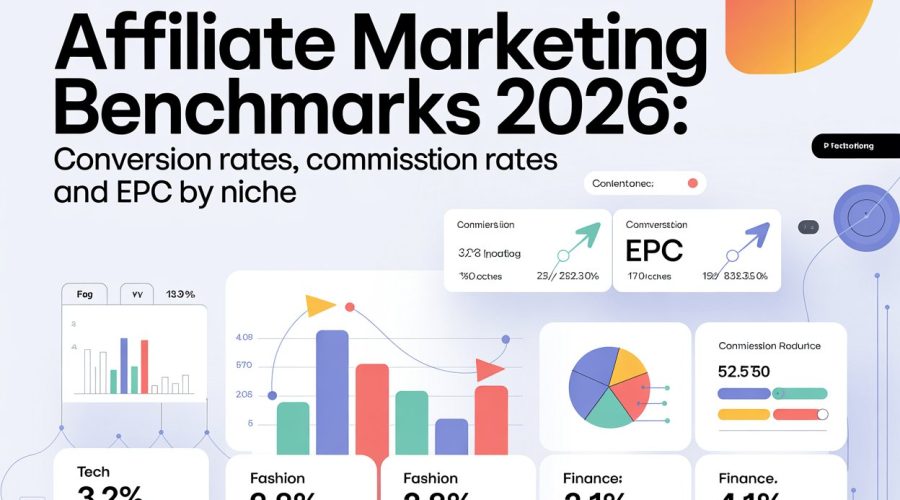
The average affiliate marketing conversion rate is 1%–3% across ecommerce programs in 2026, with high-intent niches like SaaS and financial services reaching 4%–8%. Average earnings per click (EPC) runs $0.45–$1.50 across all programs — financial services leads at $2.80 EPC, SaaS ranges $1.20–$3.50, and ecommerce averages $0.65. Commission rates span 5%–30% for physical products and 20%–70% for digital products, but EPC is the more reliable profitability signal — high commission rates mean little if conversion rates are low. Content-based affiliates convert at 2.4 times the rate of coupon-based affiliates.
Source: DollarPocket.com analysis of Authority Hacker, WeCanTrack, Impact, CJ Affiliate and Post Affiliate Pro data (2026). Full niche-by-niche breakdown below.
Affiliate marketing surpassed $10 billion in US spending for the first time in 2026 — up from $9.1 billion in 2023. The global market is now estimated at $17–20 billion, projected to reach $27–28 billion by 2027.
The $17 billion figure covers advertiser channel spend only (DemandSage, MyLead, The Affiliate Monkey). The $20 billion figure includes the broader platform and infrastructure layer (Grand View Research, Astute Analytica). Both are correct — the range reflects measurement scope, not a data conflict.
Most articles covering affiliate marketing benchmarks present vague ranges without named sources, confuse commission rates with earnings per click, or mix network-level averages with publisher-level data in ways that make the numbers meaningless for practical use.
This article separates those categories. It covers verified 2026 benchmarks for affiliate conversion rates, commission rates, earnings per click, network market share, and key performance metrics — drawn from six named primary sources covering real program and publisher data.
Sources: DemandSage / MyLead / The Affiliate Monkey 2026 (global market $17B — advertiser channel spend); Grand View Research / Astute Analytica 2026 (global market $20B — includes platform/infrastructure layer); Publift 2026 (US market $10B+); WeCanTrack Affiliate Network Statistics 2026; Impact 2025; Authority Hacker 2025–2026. Market size range note: $15.7B was the 2024 figure (Shopify/DemandSage). The 2026 consensus across named sources is $17–20B depending on measurement scope.
Affiliate Marketing Conversion Rate Benchmarks 2026
Conversion rate is the most-cited affiliate benchmark — and the most frequently misreported one. Two figures dominate the 2026 data and both are correct for different populations.
Authority Hacker's publisher-level study reports an average affiliate conversion rate of 1–2%, with top affiliates reaching 5–10%. WeCanTrack's network-level aggregate across 450+ networks reports a higher average of 2.5%. The difference reflects methodology: Authority Hacker measures at the publisher level, while WeCanTrack includes high-performing program categories that skew the average upward.
For practical benchmarking, the 1–2% figure is the more conservative and widely applicable baseline. The 2.5% network aggregate is more appropriate for benchmarking a specific affiliate program.
| Niche / Vertical | Avg Conversion Rate | Top Performer Range | Notes |
|---|---|---|---|
| Health & Pets | 5% – 6% | Up to 8% | High buyer intent; low ticket; strong trust content converts well |
| Finance & Insurance | 2% – 5% | Up to 8% (CPA-model programs) | High CVR on approved leads; heavy compliance filtering reduces effective rate |
| Software & SaaS | 2% – 4% | Up to 6% (free trial funnels) | Free trial offers convert higher; paid conversion step reduces final rate |
| Education & E-learning | 2% – 4% | Up to 7% (course launches) | Launch periods spike CVR significantly; evergreen programs average lower |
| Travel & Hospitality | 2% – 4% | Up to 5% | High AOV compensates for lower CVR; seasonal spikes significant |
| Retail & eCommerce (general) | 1% – 3% | Up to 5% (coupon/deal sites) | Fashion and apparel at lower end; home and garden trending higher |
| Beauty & Skincare | 1% – 3% | Up to 4% | High single-commission potential ($1,743 avg largest commission — Authority Hacker) |
| Web Hosting | 1% – 3% | Up to 4% | Saturated niche; high flat commissions ($50–$200/referral) offset lower CVR |
| Luxury & High-ticket | 0.5% – 1.5% | Up to 3% | Lowest CVR; highest AOV; requires trust-building content and longer lead nurture |
| Cross-niche average (publishers) | 1% – 2% | 5% – 10% (top affiliates) | Network aggregate: 2.5% (WeCanTrack) |
Sources: Authority Hacker 2025–2026 (publisher-level study); GoAffPro 2026 Affiliate Program Benchmarks; WeCanTrack Affiliate Network Statistics 2026 (450+ networks); SaaSUltra Affiliate Marketing Statistics 2026; Impact 2025. Data conflict note: publisher-level average (1–2%) vs network-level aggregate (2.5%) reflects different measurement populations — both are valid for their respective use cases.
Affiliate Commission Rate Benchmarks 2026 by Industry
Commission rates vary more across affiliate marketing than any other benchmark category — from 1% for some retail programs to 70% for premium SaaS products.
Understanding which structure applies to your niche is the foundation of affiliate program design and publisher niche selection. The data below separates flat-rate CPA structures from percentage-of-sale CPS structures.
| Industry / Niche | Commission Structure | Typical Rate / Payout | Top Program Range | Source |
|---|---|---|---|---|
| SaaS & Software | Recurring % or one-time % | 20% – 40% recurring | Up to 70% (premium programs) | Impact 2025 / Influencer Marketing Hub |
| Finance & Insurance (CPA) | Flat CPA per approved lead | $50 – $200 per lead | Up to $300 (mortgage, loans) | Cognitive Market Research 2025 / Impact 2025 |
| Web Hosting | Flat CPA per referral | $50 – $200 per referral | WP Engine / Kinsta: up to $200 | AffiliateBooster 2026 |
| Technology (CPA avg) | CPA | $133.52 avg CPA | Highest avg CPA of any category | Post Affiliate Pro 2026 |
| Insurance (CPA avg) | CPA | $82.89 avg CPA | — | Post Affiliate Pro 2026 |
| Home Goods (CPA avg) | CPA | $87.13 avg CPA | — | Post Affiliate Pro 2026 |
| Apparel & Fashion (CPA avg) | CPA or % of sale | $49.91 avg CPA / 5%–15% CPS | — | Post Affiliate Pro 2026 |
| Health & Fitness | % of sale | 3% – 20% | Up to 40% (supplement brands) | Publift 2026 |
| Retail & eCommerce (general) | % of sale (CPS) | 3% – 10% | Amazon: 1%–10% by category | Impact 2025 / Udonis 2026 |
| Amazon Associates (by category) | % of sale (CPS) | 1% – 10% depending on category | Luxury beauty: 10%; Grocery: 1% | Amazon Associates program 2026 |
| Travel & Hospitality | % of booking value | 3% – 8% | High AOV offsets lower % | Udonis / Publift 2026 |
| General CPA range (all verticals) | CPA | $3 – $200 | Finance / Tech highest; retail lowest | Post Affiliate Pro / Worldmetrics 2026 |
Sources: Post Affiliate Pro 2026 (CPA averages by category); Impact 2025 (commission structures); Udonis / Blog 2026 (retail and ecommerce rates); Publift 2026 (health, travel); AffiliateBooster 2026 (web hosting, SaaS structure benchmarks); Amazon Associates program rates 2026.
Earnings Per Click (EPC) Benchmarks 2026 by Niche
Earnings per click is the single most useful metric for affiliate publishers comparing programs across niches. It combines conversion rate and commission rate into one number: total earnings divided by total clicks.
A niche with a 5% commission rate and a 6% conversion rate will outperform a niche with a 30% commission rate and a 1% conversion rate — EPC makes that comparison immediate.
Two EPC benchmarks circulate in 2026: WeCanTrack's cross-network aggregate ($0.45 average across 450+ networks) and GoAffPro's healthy program benchmark ($0.50–$1.50 for well-managed programs). The $0.45 figure covers all traffic quality levels; the $0.50–$1.50 range is more useful for benchmarking an active, curated affiliate program.
| Niche | Avg EPC | Revenue per 1,000 Visitors | Source |
|---|---|---|---|
| Education & E-learning | High | $274 per 1,000 visitors (highest of all niches) | Authority Hacker 2026 |
| Digital Marketing / SaaS | $0.22 – $0.50+ | $236 per 1,000 visitors | Authority Hacker / WeCanTrack 2026 |
| Entertainment | Moderate | $203 per 1,000 visitors | Authority Hacker 2026 |
| Health & Wellness | $0.28 – $0.35 | Below $200 per 1,000 visitors | r/Affiliatemarketing thread Feb 2026 / Authority Hacker |
| Finance | High (varies by program) | Strong due to high CPA ($50–$300/lead) | Impact 2025 / Cognitive Market Research |
| Pets & Animals | $0.28 – $0.35 | $28 per 1,000 visitors (lowest) | Authority Hacker 2026 / Wix Blog 2026 |
| General retail / Amazon | $0.10 – $0.30 | Varies widely by category | WeCanTrack / GoAffPro 2026 |
| Cross-network average EPC | $0.45 (all traffic) / $0.50–$1.50 (healthy programs) | — | WeCanTrack 2026 / GoAffPro 2026 |
Sources: Authority Hacker 2026 (revenue per 1,000 visitors by niche, publisher-level data); WeCanTrack Affiliate Network Statistics 2026 (cross-network EPC average); Wix Blog Affiliate Marketing Statistics 2026; r/Affiliatemarketing February 2026 thread (EPC comparison between health/pets and software niches). Note: education niche EPC leads all categories at $274/1,000 visitors despite lower commission rates per sale — reflecting strong purchase intent and high AOV on e-learning products.
Affiliate Traffic Source Benchmarks 2026
Traffic source is the variable most directly within an affiliate publisher's control — and the one with the greatest impact on conversion rate. The data from Authority Hacker's publisher-level study and Impact's network data shows clear performance differences between organic search, email, social media, and paid traffic for affiliate conversions.
| Traffic Source | Share of Affiliate Traffic | CVR vs Paid Traffic | Notes |
|---|---|---|---|
| SEO / Organic search | ~78% use SEO as primary source | 10%–15% higher CVR than paid | Highest intent traffic; compound growth; scales without ongoing cost |
| Email marketing | ~30% of new affiliates report highest CVR from email | +29% CVR with personalisation vs non-personalised | Highest CVR of any source when list is segmented and warmed |
| Social media (organic) | ~25% of affiliate traffic | Lower than organic search | 40% of new affiliates use social as primary source; Instagram/TikTok growing fastest |
| YouTube (video reviews) | Growing — video projected 55% of affiliate traffic by end 2026 | 3× CVR of blog posts in same niche (anecdotal, r/Affiliatemarketing Jan 2026) | Long-form YouTube reviews highest CVR; harder to scale than blog content |
| Mobile traffic (all sources) | 55%–62% of all affiliate-driven traffic | Lower CVR on mobile vs desktop if landing page is not optimised | WeCanTrack: 55%; SaaSUltra / FirstPromoter: 62% — both reflect mobile majority |
| Paid traffic (PPC / paid social) | Minority of affiliate strategies | Baseline (10–15% lower than organic) | Margins tighter as ad costs rise; requires careful EPC-to-CPC calculation |
Sources: Authority Hacker 2025–2026 (SEO as primary traffic source: 78%); WeCanTrack Affiliate Conversion Statistics 2026 (organic vs paid CVR differential: 10–15%; mobile share: 55%); Impact 2025 (social media share: 25%); SaaSUltra / FirstPromoter 2026 (mobile share: 62% — higher figure reflecting newer data); Udonis 2026 (video traffic projection). Mobile range of 55%–62% reflects different measurement periods and populations across sources — both confirm mobile majority. YouTube 3× CVR figure is sourced from a highly upvoted community thread — directionally consistent with platform data but not from a named formal study; treat as indicative rather than precise.
Affiliate Network Market Share and Program Benchmarks 2026
The affiliate network landscape is highly concentrated at the top. Amazon Associates alone holds 48.23% market share by program count, followed by Rakuten, ShareASale, and CJ Affiliate. For program-level benchmarks, the key metrics to track are active affiliate rate, average order value, and cookie window length — each of which directly determines program revenue potential.
| Network | Market Share | Speciality | Best For |
|---|---|---|---|
| Amazon Associates | 48.23% | Physical products, all categories | Content sites, review blogs, comparison content |
| Rakuten Advertising | Second largest | Retail, fashion, lifestyle brands | Fashion and lifestyle publishers |
| ShareASale | Third largest | Diverse — 4,500+ merchants | Niche publishers; B2B and B2C mix |
| CJ Affiliate | Major (top 4) | Enterprise brands, travel, finance | Publishers with significant traffic volume |
| PartnerStack | Growing rapidly | SaaS & B2B software | SaaS-focused publishers; highest recurring commission programs |
| Impact | Growing — enterprise focus | Performance partnerships, DTC brands | Large publishers; influencer-affiliate hybrid programs |
| Top 5 networks combined | 60% of total affiliate revenue | — | Market highly concentrated at top |
Sources: Post Affiliate Pro 2026 (Amazon Associates 48.23% market share); WeCanTrack Affiliate Network Statistics 2026 (top 5 networks: 60% of revenue); AffiliateBooster 2026 (PartnerStack for SaaS); Publift 2026; Udonis Blog 2026.
Affiliate Program Performance Benchmarks 2026
For advertisers running affiliate programs, these are the key operational benchmarks that determine whether a program is healthy or underperforming. The most important and least-discussed benchmark is active affiliate rate — the percentage of enrolled affiliates who generate at least one sale per month. In almost every program, 90% of revenue comes from the top 10% of affiliates, regardless of how many total affiliates are enrolled.
| Metric | Benchmark | Source |
|---|---|---|
| Active affiliate rate (generating ≥1 sale/month) | 10% – 20% of total enrolled affiliates | GoAffPro 2026 |
| Revenue concentration (90/10 rule) | Top 10% of affiliates generate 90% of revenue | GoAffPro 2026 / Industry consensus |
| Avg cost to acquire first affiliate sale (new programs) | $50 | WeCanTrack Affiliate Network Statistics 2026 |
| Avg ROAS for advertisers using affiliate channel | 12:1 – 15:1 | Authority Hacker 2025 / SaaSUltra 2026 |
| Share of ecommerce revenue from affiliate channel (US) | 16% | Publift 2026 / SaaSUltra 2026 |
| Gifted influencer collaborations vs paid sponsorships CVR | Gifted: 12.9% higher engagement (2.19% vs 1.94%) | Social Cat Influencer Marketing Report 2026 |
| UGC impact on conversion rate | +28% CVR vs non-UGC content | Stackla / Nosto 2026 |
| Affiliate fraud rate (non-human / invalid traffic) | Up to 17% of affiliate clicks | Post Affiliate Pro 2026 / Jupiter Research |
| eCommerce businesses using affiliate programs by 2026 | Over 90% | Wix Blog Affiliate Statistics 2026 |
| Networks moving away from cookie-based tracking | 70% switching to first-party / AI tracking | Wix Blog Affiliate Statistics 2026 |
Sources: GoAffPro 2026 Affiliate Program Benchmarks; WeCanTrack Affiliate Network Statistics 2026; Authority Hacker 2025–2026; SaaSUltra Affiliate Marketing Statistics 2026; Publift 2026; Social Cat Influencer Marketing Report 2026; Stackla/Nosto 2026; Post Affiliate Pro 2026; Jupiter Research (fraud estimate); Wix Blog Affiliate Marketing Statistics 2026.
TikTok Shop Affiliate Benchmarks 2026: The Fastest-Growing Platform
TikTok Shop is the most significant new development in affiliate marketing in 2026. TikTok Shop affiliate GMV grew 312% year-over-year in 2025, making it the fastest single-platform expansion in affiliate marketing history. US TikTok Shop sales are projected at $23.4 billion in 2026.
TikTok Shop operates on a creator-affiliate hybrid model. Creators apply products to their content, earn commissions on sales from their videos or livestreams, and are paid directly through the platform.
This is structurally different from traditional affiliate marketing — there is no separate landing page, no cookie window, and no separate affiliate network. The conversion happens inside the app. Commission rates range from 5%–20% depending on product category, with beauty, fashion, and home goods as the highest-volume categories.
Affiliate income from TikTok Shop now accounts for 11% of creator earnings — growing at 71% year-over-year, the fastest growth rate of any creator income source according to Impact and Fanvue's 2026 creator economy data.
| TikTok Shop Affiliate Metric | Benchmark | Source |
|---|---|---|
| TikTok Shop affiliate GMV growth (YoY 2025) | +312% | The Affiliate Monkey 2026 |
| Projected US TikTok Shop sales 2026 | $23.4 billion | AutoFaceless / SaaSUltra 2026 |
| TikTok Shop commission rate range | 5% – 20% (varies by product category) | TikTok Shop Affiliate Program 2026 |
| Share of creator earnings from affiliate (TikTok) | 11% of total creator income | Impact / Fanvue Creator Economy Report 2026 |
| YoY growth rate of affiliate revenue among creators | +71% — fastest of any creator income source | Impact / Fanvue Creator Economy Report 2026 |
| Top TikTok Shop categories by volume | Beauty, Fashion, Home & Kitchen, Health | TikTok Shop seller data 2026 |
Sources: The Affiliate Monkey 2026 (312% GMV growth); AutoFaceless / SaaSUltra 2026 ($23.4B US projection); Impact / Fanvue Creator Economy Report 2026 (11% share, 71% YoY growth). Note: TikTok Shop affiliate data is emerging and subject to more rapid revision than established network benchmarks — figures reflect Q1 2026 reporting.
Affiliate Marketer Income and Niche Revenue Benchmarks 2026
Affiliate income data is the most frequently inflated benchmark category in the industry. Most published income figures come from surveys of self-selected active marketers — which excludes the majority who earn little or nothing.
The Authority Hacker publisher income study is the most rigorous available. It surveyed active affiliate marketers with documented traffic and revenue, making it more reliable than general polls that include inactive or beginner accounts.
| Metric | Data Point | Source |
|---|---|---|
| Education / e-learning avg monthly revenue | ~$15,551/month (highest niche) | Thunderbit / Authority Hacker 2026 |
| Travel niche avg monthly revenue | ~$13,847/month | Thunderbit 2026 |
| Affiliate marketers earning under $10,000/year | Majority of active affiliates | SaaSUltra 2026 |
| Affiliate marketers earning over $150,000/year | 3% of active affiliates | Thunderbit 2026 |
| Affiliates achieving >3% CVR in first 6 months | 20% of new marketers | WeCanTrack Affiliate Network Statistics 2026 |
| Time to meaningful revenue (new affiliates) | 6–12 months | WeCanTrack / industry consensus |
| Beauty & skincare avg largest single commission | $1,743 (highest avg single commission) | Authority Hacker / Wix Blog 2026 |
| Commission structure preference (2026 survey) | 62% prefer recurring over higher one-time rates | AffiliateBooster 2026 affiliate survey |
| AI tool usage among affiliate marketers | Nearly 60% use AI for content, SEO, or campaign analysis | Thunderbit 2026 |
Sources: Thunderbit Affiliate Marketing Statistics 2026; Authority Hacker 2025–2026 (publisher income and EPC by niche); WeCanTrack Affiliate Network Statistics 2026; AffiliateBooster Commission Survey 2026; Wix Blog Affiliate Marketing Statistics 2026. Income data caveat: all figures are from surveys of active, self-identified affiliate marketers with documented revenue — not population-wide estimates. The majority of individuals who attempt affiliate marketing earn nothing or quit within the first year.
For related benchmark data on DollarPocket.com, see the Best Recurring Affiliate Programs guide covering the highest-paying recurring commission programs across niches, the Email Marketing Benchmarks 2026 for data on the highest-converting affiliate traffic channel, and the Google Ads Benchmarks 2026 for paid traffic cost benchmarks relevant to affiliates using PPC strategies.
Suggested attribution: DollarPocket.com Editorial Team. "Affiliate Marketing Benchmarks 2026: Conversion Rates, Commission Rates and EPC by Niche." DollarPocket.com. April 2026. https://www.dollarpocket.com/affiliate-marketing-benchmarks-2026/



Comments (0)